A surrogate model for nonlinear dynamics in the Lattice Boltzmann method
A simple but rigorous explanation of how a projection-based collision step can make quantum lattice Boltzmann simulations more coherent.
In this post, I want to share the main idea behind a recent paper I wrote with Matthias Moeller and Norbert Hosters, "Quantum Lattice Boltzmann with Denoising Collision Operators" [1]. The paper is technical, but the motivation is simple: if we want quantum computers to simulate fluids, we need a way to handle the nonlinearity of fluid dynamics.
Lattice Boltzmann method#
The lattice Boltzmann method, or LBM, describes a fluid through particle populations living on a lattice. The particles can only travel along a finite, predetermined set of velocities. At each grid point, we store a small set of numbers \(f_i(x,t)\), one for each discrete velocity direction \(c_i\). LBM is a time-marching method in which each time step involves two main dynamical processes. First, collision changes the local populations so they relax toward an equilibrium distribution. Second, streaming moves each population to a neighboring lattice node along its velocity direction. The diagram below depicts a simple 2D lattice configuration.
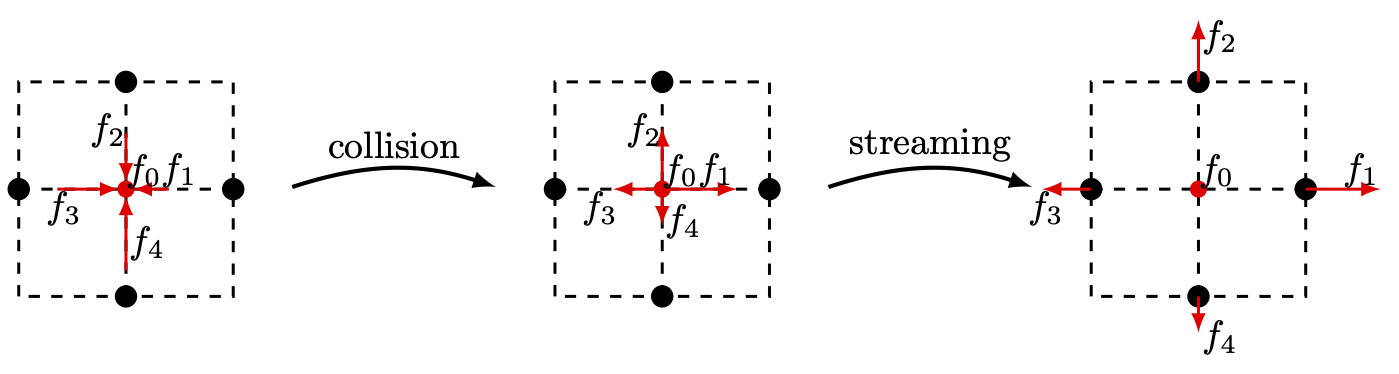
On a quantum computer, streaming is friendly. It is basically a reversible shift: if the velocity register says "move right", add one to the x coordinate; if it says "move up", shift in that direction, and so on. Collision is the hard part. In classical LBM, the equilibrium distribution depends on density and velocity, and the velocity terms contain nonlinear products. The relaxation toward equilibrium is also dissipative: information about the initial distribution is lost. This poses the main difficulty for simulating the LBM on quantum computers since quantum operators, by contrast, are linear and reversible.
Treatment of the nonlinear collision#
Many quantum LBM approaches implement the collision step by interrupting the quantum evolution. They measure the state, reconstruct enough classical information, compute a new equilibrium, and prepare a fresh state. That can be useful for proofs of concept, but it pays a large measurement and state-preparation cost at every time step. Other approaches use larger linear embeddings, such as Carleman-type ideas, but those can lead to deep circuits and difficult resource requirements. Our question was whether we could reinterpret the collision step so that it becomes implementable by quantum-native operations.
The approach we explore is to treat initial distributions as out-of-equilibrium signals that undergo a denoising process as they relax back toward equilibrium. In this interpretation, the collision step implements that relaxation.
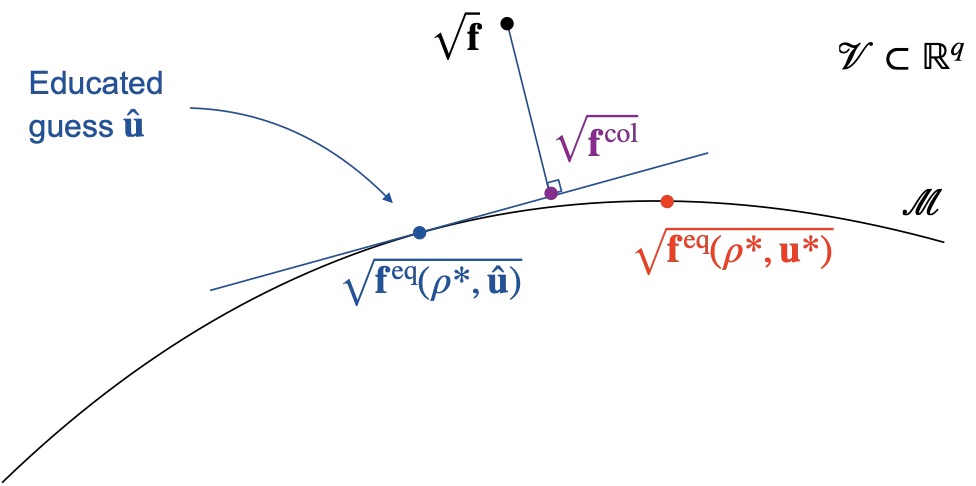
Geometrically, all equilibrium LBM populations form a high-dimensional smooth surface, or manifold, inside the space of local population vectors. Each point on this manifold corresponds to an equilibrium determined by a density \(\rho\) and velocity \(\mathbf{u}\). After streaming, the local state is generally nudged away from this equilibrium manifold. In classical LBM, collision pulls it back toward equilibrium. Instead of computing the full nonlinear pullback directly, we approximate the nearby equilibrium surface by its tangent space around a chosen reference velocity \(\hat{\mathbf{u}}\). Then collision is modelled as an orthogonal projection onto the tangent space.
More precisely, the quantum state stores square-root amplitudes of the particle populations. We will not go into details about the encoding state, but it encodes vectors of the form \(\sqrt{\mathbf{f}} = (\sqrt{f_1}, \dots, \sqrt{f_q})\), where \(q\) is the size of the velocity set. The equilibrium manifold is described by vectors of the form \(\sqrt{\mathbf{f}^{\mathrm{eq}}(\rho,u)}\). Around a reference velocity \(\hat{\mathbf{u}}\), we build a Jacobian \(J\) whose columns are partial derivatives with respect to \(\rho\) and \(\mathbf{u}\), which span the local linearization of this manifold. The denoising collision operator is the projector
As a projection onto the linearized manifold at \(\hat{\mathbf{u}}\), this operator removes components orthogonal to the local equilibrium geometry. We called it a denoising operator because it filters out local non-equilibrium noise. The following figure is a simplified scheme in which the post-collision state \(\sqrt{\mathbf{f}^{\mathrm{col}}}\) lies on the tangent line at a reference point on the manifold.
Results and outlook#
The rest of the paper analyzes the properties and errors of this operator and builds a full quantum pipeline around it. The collision operator itself is not unitary, so we implement it through block encoding with an ancilla. The paper also includes circuit implementations of multi-timestep LBM simulations with simple boundary conditions.
The numerical experiments are encouraging, with an important caveat: the reference velocity is the main practical lever. The current experiments show that a good \(\hat{\mathbf{u}}\) can make the projection behave like a useful collision operator, while a bad one can visibly degrade the simulation. One natural next step is to make \(\hat{\mathbf{u}}\) position- and time-dependent, ideally without making the circuit depth explode. Another is to extend the framework beyond the full-relaxation setting used here so that viscosity can be tuned more flexibly.
There is also a larger quantum-algorithmic issue that involves post-selection. Even if one collision step succeeds with high probability, repeated time steps multiply the failure probabilities. We show that standard oblivious amplitude amplification does not solve this for an orthogonal projector. As an outlook, we describe a possible deterministic route using double-bracket quantum algorithms, replacing post-selected projection with a coherent evolution generated by \(H = I - D\). This is not yet an efficient recipe, but it points toward fully coherent multi-timestep quantum LBM.
For me, the main message is that nonlinear physics does not always need to be imported into quantum algorithms through direct, sequential arithmetic. Sometimes it is possible to take advantage of the geometric structure that the nonlinear dynamics enforce. In this case, collision is interpreted as denoising, which is effectively approximated by a projection.
The implementation is available on GitHub, with an archived version on Zenodo.
References
- Trong Duong, Matthias Möller, and Norbert Hosters (2026). Quantum Lattice Boltzmann with Denoising Collision Operators. arXiv:2604.09997.